
How Does Content Chunking Improve Entity Recognition and Semantic SEO?
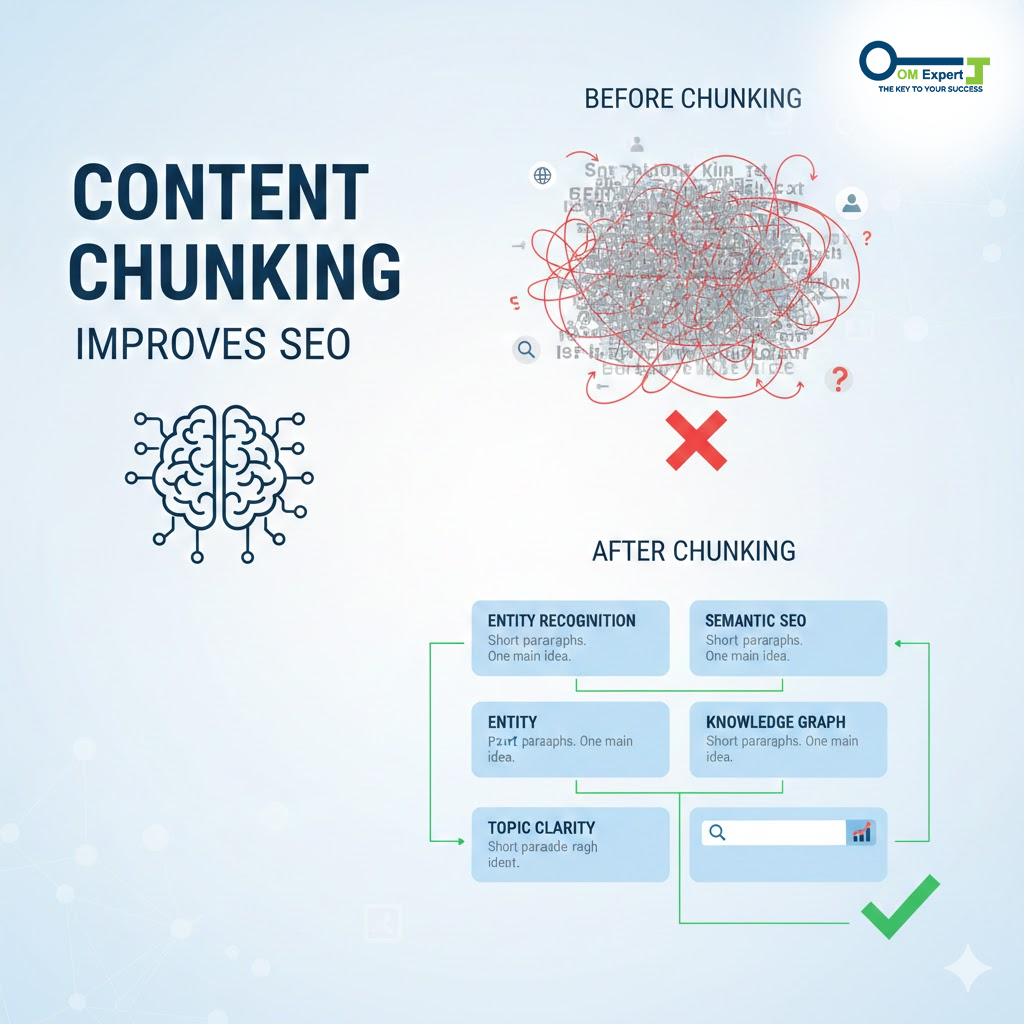
Understanding how search engines explain information has become one of the most important parts of modern SEO. Few individuals discuss structure, whereas many concentrate on technical audits, backlinks and keywords. Structure is the backbone of clarity, and clarity is what helps search engines understand exactly what your page is about. This is where content chunking comes in. It is a simple writing method, yet it can dramatically improve how search engines process, identify, and rank your content.
In this blog, you will learn how content chunking helps search engines recognize entities, why it boosts semantic SEO, and how to apply it in your writing. The language is simple, the process is easy, and the results are powerful for long term ranking.
Introduction to Entity Recognition and Semantic SEO
Google no longer looks only at keywords. It tries to understand meanings, relationships, and topics. This is called semantic SEO. For Google to understand your content, it must correctly identify entities. An entity can be a person, place, topic, product, idea or tool.
When writing in long blocks of text, search engines struggle to understand the relationships between topics. This is why content chunking becomes valuable at every stage of optimization. It helps both humans and search engines move through information smoothly. When your page is easy to understand, you rank better.
What Exactly is Entity Recognition
Entity recognition is a process used by search engines and large language models to detect important words in your content. These words are then stored as signals that explain what your page is about.
For example
- Apple is a company
- Paris is a city
- SEO is a digital marketing process
If your page mixes many topics in a single paragraph, Google may get confused. This reduces clarity. When you apply content chunking, it separates ideas into small, meaningful blocks, making it easier for the search engine to map each entity to the correct topic. Clear blocks create a clear understanding.
Why Search Engines Love Clean Structure
Clean structure helps Google follow your content without guessing. Consider your own reading preferences. You like concise explanations, distinct titles and short sections. Google is very similar. It reads your page the way humans do. If your paragraphs are too long, the message becomes unclear.
Using content chunking helps you organize content so your main points stand out. Search engines can easily scan the page and find important details. This improves understanding, and better understanding increases ranking strength.
How Content Chunking Supports Semantic SEO

Delivering meaning rather than just keywords is the main goal of semantic SEO. Google is interested in learning what your page teaches. If your text is messy, long, or unfocused, the meaning gets lost. When you use content chunking, every section becomes a clear idea, and this makes the meaning of your content easy to identify.
Here is how chunking helps semantic SEO:
- It connects ideas smoothly
- It highlights important concepts
- It improves topic flow
- It increases readability
- It reduces confusion
When meaning is clear, semantic SEO works at its best.
How Chunking Improves Entity Recognition
Entity recognition depends on clarity. Search engines need to understand which terms belong together and which concepts form the core message of your page. When ideas are mixed inside a long paragraph, Google struggles to detect the correct meaning. This can weaken your visibility for important topics and lower your overall relevance.
When ideas are grouped neatly in separate chunks, each section becomes a clear signal. Search engines can recognize which entities relate to one another based on the topic inside each chunk. This improves how your content is interpreted and how it is mapped inside Google’s systems.
By using content chunking, you help search engines understand your message without confusion. Each block represents one idea, one topic, or one mini concept. This gives Google a clean path to follow while reading your page. It also reduces the chance of misinterpreting your content, which improves accuracy on search results.
This is why well-chunked pages often win featured snippets, paragraph snippets and list snippets. Content that is simple to extract, read and categorize is preferred by Google. When search engines understand your content, they reward it with stronger visibility, improved ranks and more consistent SEO performance.
Chunking is not only a formatting choice. It becomes a powerful structure that helps Google match your content with the right audience, which increases organic traffic and topic authority in the long run.
The Psychological Side of Chunking
Information is easier for readers to understand when it is presented in manageable chunks. Long text blocks are difficult for human brains to digest; thus, they dislike them. Short sections feel lighter, friendlier and easier to follow. This reduces mental strain and helps visitors absorb your message with comfort.
They stay longer on your page when users find your content easy to read. This increased time on page sends a positive signal to search engines. It shows that your content is valuable and enjoyable. Google notices these signals and may reward your page with stronger ranking potential.
Using content chunking is not only an SEO approach. It is also a psychological method. You present information in a structure that aligns with natural reading behavior. People prefer clarity. They prefer simple guidance. They like reading content that flows smoothly without effort.
Chunking also helps users revisit your content easily. When they scroll back, they can find what they need quickly because every idea has its own place. This improves content satisfaction and builds trust between your website and your readers.
Engagement is the quiet force behind strong SEO. Search engines consider it an indication of quality when users engage with your page, browse through your content, or take the time to consider your thoughts. This is why chunked content often becomes more shareable, more memorable and more effective for long-term success.
The Role of Headings in Chunking
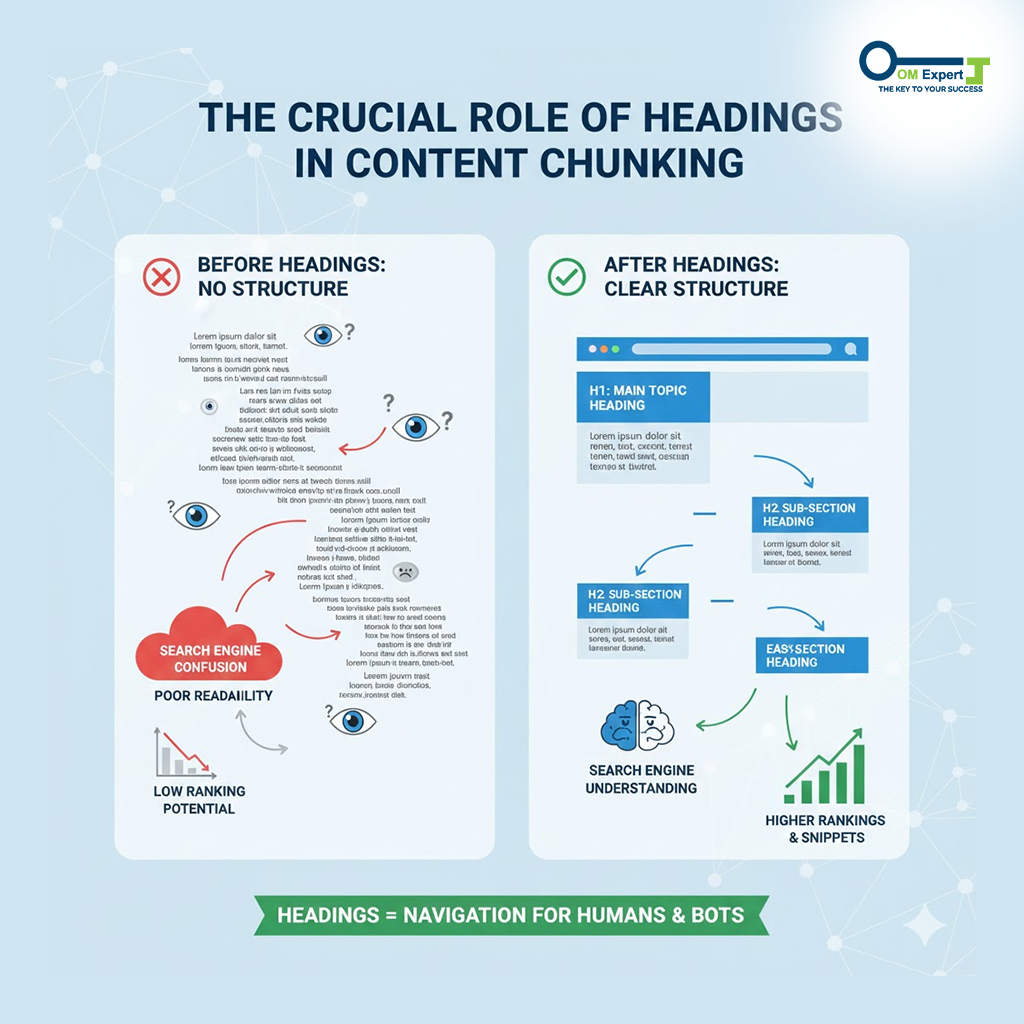
Headings break your content into logical parts. They guide readers step by step through your message. They also act as clear signposts for search engines. Each heading tells Google what the next section covers. This makes it easier for the search engine to understand your structure and match your content to relevant search terms.
Chunking is supported by strong titles that provide a clear space for each item. Your paragraph can remain focused and essential when the title presents a clear point. This improves the readability of your material for both people and search engines.
Headings can be used to display topic order and depth by using content chunking. This tells search engines how your ideas connect to each other and why your content is relevant to a specific keyword or question. Good headings help Google understand your content faster and more accurately.
Headings also improve user experience. When visitors scan your page, they can quickly identify the parts they want to read. A smooth reading journey makes them feel comfortable and more likely to stay longer. Clear sections reduce confusion and improve content flow.
Effective headers facilitate simple reading, knowledge and ranking of your material. They build a solid framework that simultaneously improves SEO performance and user happiness.
Examples of Strong Content Chunks
Here are simple examples of effective chunking:
Good Chunk
- Short paragraph
- One idea
- Clear heading
- Easy to read
Bad Chunk
- Long text
- Many ideas mixed
- No breaks
- Hard to follow
Strong pages always choose the first style because it supports content chunking at every step.
How Chunking Helps Search Engines Build Knowledge Graph Connections
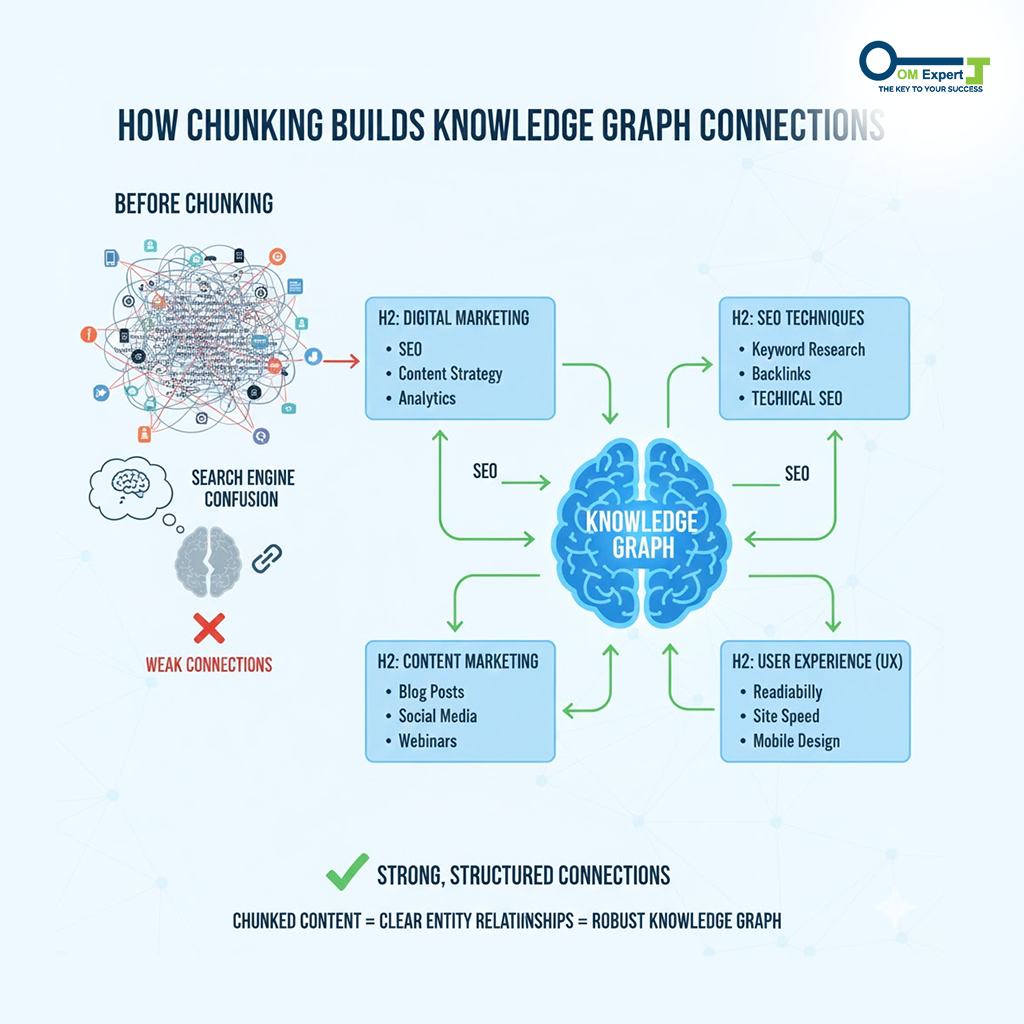
Google uses a Knowledge Graph to store entity relationships. Google can understand your content better when it is clear. Google needs to see how SEO, content strategy, analytics and user experience connect when you write about digital marketing.
Using content chunking helps Google draw correct connections. It ensures your ideas are separated, grouped, and easy to interpret. This gives your page a higher chance of becoming a strong authority in your niche. Connections build trust in the eyes of search engines.
How Chunking Helps Avoid Misinterpretation
When content is mixed, Google may misinterpret the meaning. This happens when too many topics overlap. Chunking avoids this. It keeps ideas clean and prevents search engines from mixing unrelated information.
This is why many websites that do not use content chunking often struggle with ranking. Their message becomes diluted and weak. Clear separation keeps your content powerful and direct.
When Google understands your content correctly, you rank more accurately.
How Chunking Improves Snippet Chances
Featured snippets rely on a clear structure. Google prefers content that is easy to extract and reuse. When you use content chunking, you make your content extraction friendly. This significantly increases the chance of earning list snippets, paragraph snippets, and how-to snippets.
If you want to win more snippets, a clean structure is essential. Chunking helps you deliver information in a format that Google loves. Snippets come from clarity.
How Chunking Helps with Reader Retention
Readers stay longer when your page is easy to scan. Long blocks of text push readers away. When someone leaves your page quickly, it sends a negative signal to Google.
Using content chunking keeps users engaged. They scroll, explore, and read more. This increases dwell time, which is an important ranking factor. Better user experience equals better performance. Simple formatting can improve SEO more than you expect.
Listing Format Example of Chunking Benefits
Here are some quick ways chunking supports SEO:
- Better readability
- Improved entity mapping
- Stronger topic clarity
- Higher snippet potential
- Longer user engagement
- Stronger semantic signals
- Clearer writing
- Better structure for search engines
- More organized ideas
- Cleaner interpretation
These points highlight how content chunking acts as a foundation for great content.
How to Apply Chunking in Your Writing
Chunking is simple to apply if you follow a few guidelines. You can employ this easy technique:
- Use short paragraphs
- Add headings for each idea
- Write one concept per section
- Use lists where helpful
- Add spacing for comfort
- Follow natural flow
- Keep your language simple
When you combine these steps, you naturally create stronger content. Strong content always starts with structure.
How Chunking Helps Future-Proof SEO
Search engines continue to evolve. They rely more on meaning and context than ever before. Structured content is future-proof because machine learning systems can read it easily.
With content chunking, you align your writing with what search engines expect. Clear, meaningful content will always rank better than confusing text. Chunking keeps your pages ready for future updates and readability improvements. The structure is staying. Confusion is not.
Conclusion
Content that is clear, structured, and readable always performs better. This is why content chunking is one of the most powerful writing techniques for improving entity recognition and boosting semantic SEO. It helps readers, it helps search engines, and it creates a strong foundation for long-term ranking success. If you want your website to achieve meaningful visibility, a strong structure must be part of your strategy. For simpler and effective content improvement guidance, you can always learn from the resources shared by the OM Expert.
FAQ
1.Why is content chunking useful?
Content chunking helps search engines understand ideas clearly while improving readability, engagement and overall ranking performance for users.
2.How does chunking improve entities?
Chunking separates ideas cleanly, helping Google correctly identify important terms and map them to the right topics.
3.Does chunking boost snippet chances?
Yes, because clean sections, short paragraphs and simple lists make your content easier for Google to extract quickly.
4.Can chunking increase user engagement?
Chunking improves readability, keeps users scrolling longer, reduces confusion and sends strong quality signals to search engines.
5.Is chunking good for future SEO?
Yes, structured content is easier for machine learning systems to read, understand and rank accurately over time.