
What is AI-Driven SEO? Optimizing for Perplexity, ChatGPT, and Gemini
Let’s be honest for a second: SEO feels a little scary right now, doesn’t it?
For the last 15 years, the game was predictable. You picked a keyword, wrote a decent blog post, built a few links, and watched your site climb the ladder of Google’s “ten blue links.” It wasn’t easy, but the rules were clear.
Today, you type a question into Google, and before you even see a website, an AI reads the entire internet, synthesizes the answer, and serves it to you on a silver platter.
The user gets their answer. They smile. They leave. And they never visit your website.
This is the “Zero-Click” reality we are living in. But here is the good news: you don’t have to die in this new world. You just have to evolve. This evolution is called AI-Driven SEO.
If you are wondering, “Is my traffic going to zero?” or “How do I get featured in that AI box?”, you are in the right place. This guide isn’t just a definition; it’s a survival manual. We are going to break down exactly what is AI-Driven SEO, how it differs from the old school tactics, and the specific steps you need to take to ensure ChatGPT, Perplexity, and Gemini recommend you instead of your competitor.
What is AI-Driven SEO? (Really?)
To master this, we need to strip away the buzzwords.
AI-Driven SEO is not about using ChatGPT to write lazy blog posts. That’s actually the fastest way to lose rankings.
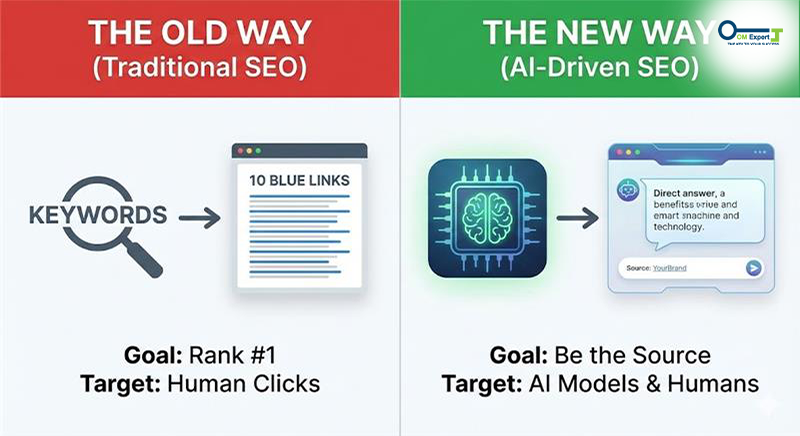
AI-Driven SEO is the strategic process of optimizing your digital presence so that Generative AI models (like Google’s Gemini, ChatGPT, and Perplexity) can understand, trust, and cite your brand as the definitive source of truth.
Think of it this way:
- Traditional SEO was like trying to be the most popular book in the library so people would check you out.
- AI-Driven SEO is like trying to convince the Librarian (the AI) that you are the smartest expert in the room, so when someone asks a question, the Librarian quotes you directly.
The goal has shifted. We aren’t just hunting for clicks anymore. We are hunting for “Share of Voice” inside the AI answer. When a user asks, “What is the best CRM for small business?”, you want the AI to say: “According to recent data, [Your Brand] is a top choice because…”
That mention? That is the new gold standard.
The New Language (GEO, AEO, and AIO)
If you hang around marketing circles, you are going to hear a lot of acronyms. Let’s decode them so you don’t feel lost.
1. AIO (AI Overviews)
This is the feature you see at the top of Google. It’s that shaded box that answers your question immediately. Ranking here is the holy grail of AI-Driven SEO because it occupies the entire “above the fold” space on mobile screens.
2. GEO (Generative Engine Optimization)
This is the broad term for the industry. GEO is the art of formatting content for machines that “read” differently than humans. It involves understanding how Large Language Models (LLMs) connect dots between different topics.
3. AEO (Answer Engine Optimization)
This is a specific subset of AI-Driven SEO. It focuses purely on being the direct answer. Think of voice search (Siri/Alexa) or concise chatbot queries. AEO requires short, punchy, factual answers.
The Bottom Line:
You can’t just “do SEO” anymore. You need a hybrid approach. You need the technical foundation of traditional SEO, but you need the content strategy of AI-Driven SEO.
Why Traditional Tactics Are Failing
Why can’t you just keep doing what you’ve always done?
Because AI models have a “BS detector” that is far more sophisticated than old algorithms. In the past, you could trick Google by stuffing keywords like AI-Driven SEO into the footer or buying cheap links.
Generative AI doesn’t care about that. It cares about Semantic Understanding.
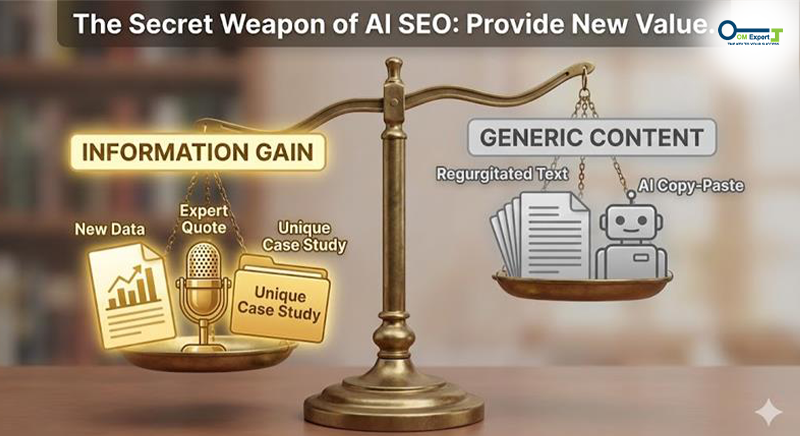
If you write a 2,000-word article that effectively says nothing new, the AI will ignore it. It has already read the Wikipedia page; it doesn’t need your regurgitated version. This brings us to the most important concept in this entire guide: Information Gain.
Pillars of Winning at AI-Driven SEO
Okay, enough theory. Let’s get into the “How-To.” If you want to rank in 2025/2026, you need to rebuild your content strategy around these four pillars.
Pillar 1: Information Gain (The “New Data” Requirement)
We mentioned this earlier, but it bears repeating. Google has a patent literally called “Information Gain scores.”
Here is the reality: AI-Driven SEO relies on you adding something new to the internet. If an AI reads 10 articles on “How to Bake a Cake” and they all list the exact same ingredients and steps, the AI will just synthesize one generic answer. It won’t cite anyone specific.
But, if your article says, “We tested 5 different flour brands, and Brand X created a 20% fluffier cake,” boom—you have Information Gain.
How to do it:
- Run micro-experiments: Don’t just write about a tool; test it and publish the results.
- Survey your audience: “We asked 100 CEOs about their budget…” creates unique data that only you own.
- Contrarian takes: If everyone says “X is good,” explain why “X might actually be bad in specific cases.” AI finds nuance interesting.
Pillar 2: Entity-Based SEO (Speaking the Robot’s Language)
This is technical, but stick with me. Humans read words; robots understand “Entities.”
An entity is a thing—a person, place, concept, or brand. In AI-Driven SEO, you need to make sure the AI understands who you are and what you are an expert in.
If you are writing about “Apple,” does the AI know if you mean the fruit or the iPhone company? You clarify this by connecting entities.
How to do it:
- Stop worrying about keyword density. Start worrying about Topic Coverage.
- If you write about “AI Marketing,” you must also mention related entities like “Machine Learning,” “Automation Tools,” “Data Privacy,” and “Personalization.”
- Use a tool like InLinks or simple Wikipedia research to see what other topics are mathematically connected to your main topic.
Pillar 3: The “Answer Sandwich” Format
This is a specific writing technique tailored for Answer Engine Optimization (AEO). AI models are busy; they don’t want to dig through a 500-word intro about your grandmother’s childhood to find the recipe.
You need to feed them the answer immediately.
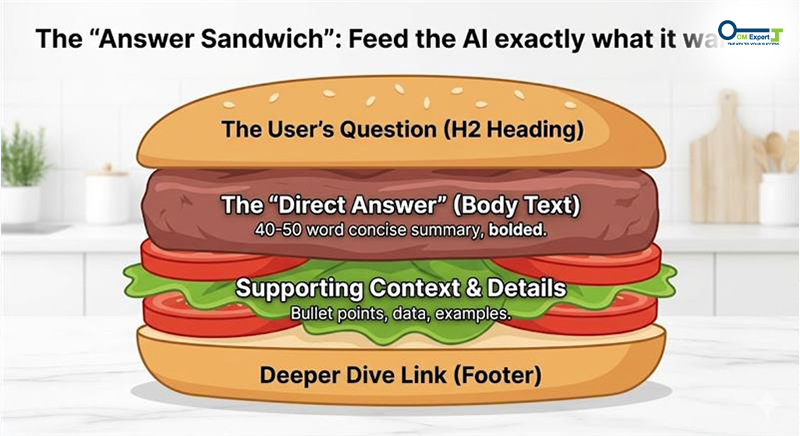
The Structure:
- The Question (H2 Heading): e.g., “What are the benefits of AI-Driven SEO?”
- The Direct Answer (Body): A 40-50 word bolded summary answering the question directly.
- The Context: Bullet points explaining the details.
This structure is catnip for Google’s crawlers. It makes it incredibly easy for them to grab that snippet and throw it into the Google AI Overview at the top of the search results.
Pillar 4: Digital PR & LLM Citations
Links are still important, but LLM Citations are the future.
An LLM citation is when a trusted source (like Forbes, The New York Times, or a major industry blog) mentions your brand name in the context of a topic. The AI reads that site, sees your name, and associates you with that topic.
AI-Driven SEO is about brand association. If you want to rank for “Best Coffee,” you need the AI to see the words “Your Brand” and “Best Coffee” appearing together on other high-authority sites.
Optimizing for Specific Platforms
Not all AI is created equal. The strategy you use for Google might not work for Perplexity AI SEO. Here is how to tailor your AI-Driven SEO for the “Big Three.”
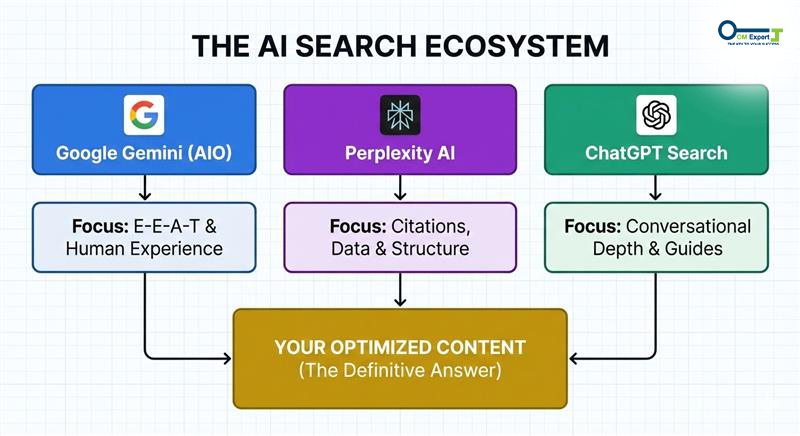
1. Ranking in Google Gemini (The King)
Google is still the boss. Their AI Overview (AIO) is driven by their “Helpful Content” system.
- The Secret: E-E-A-T (Experience, Expertise, Authority, Trust).
- The Strategy: Use “I” statements. “In my 10 years of experience…” or “We tested this strategy…”. Google’s AI is specifically trained to value human experience because it is the one thing AI cannot fake.
- Format: Use clear HTML tables. Google Gemini loves pulling data from tables to display in snapshots.
2. Ranking in Perplexity (The Citation Engine)
Perplexity is arguably the most interesting player. It doesn’t just give an answer; it aggressively cites its sources with little footnotes.
- The Secret: Academic accuracy and structure.
- The Strategy: Perplexity loves “Listicles” and clear definitions. It struggles with long, flowing prose. Break your content into rigid, logical steps.
- The Hack: Cite other credible sources in your content. Perplexity seems to trust content that links out to other high-authority data (e.g., gov sites or research papers).
3. Optimizing for ChatGPT Search (The Conversationalist)
ChatGPT is different. It wants to have a chat.
- The Secret: Conversational depth.
- The Strategy: Write long-form guides that anticipate the next question. If you answer “What is AI-Driven SEO?”, immediately follow up with “How do I implement it?” and “What tools do I need?”. ChatGPT rewards content that covers the entire user journey in one place.
The Risks of AI-Driven SEO
We have painted a rosy picture, but we need to be realistic. There are risks involved in this shift.
The biggest risk is the “Zero-click search strategy” traffic drop. As AI answers more questions directly, fewer people will click your links. This is a fact.
However, the traffic that does click through? It is higher quality.
Think about it. If someone gets a quick answer from AI, they were likely just browsing. But if someone reads the AI answer and still decides to click your link, they are deeply interested. They are a qualified lead.
AI-Driven SEO is not about volume; it is about value. You might see 20% less traffic, but 20% more conversions because the people arriving at your site are serious buyers.
Another risk is Hallucination. Sometimes, AI gets it wrong. It might say your product does something it doesn’t do. The only defense against this is to ensure your website’s “About Us” and “Product” pages are crystal clear, schema-marked, and unambiguous. You need to train the AI on who you are.
Actionable Checklist for Your Next Blog Post
Ready to write? Don’t just open a doc and start typing. Use this AI-Driven SEO checklist to ensure every piece of content you publish is optimized for the future.
- Check for “Information Gain”: Do I have at least one unique stat, quote, or personal story that isn’t on Page 1 of Google?
- Schema Markup: Have I wrapped my FAQs in FAQPage schema? Have I used Article schema?
- The Definition: Did I answer the main “What is…” question in the first 100 words?
- Entity Linking: Did I mention at least 5-10 related topics/concepts to build context?
- Scannability: Is there a bulleted list? Is there a table? (AI models love tables).
- Multimedia: Did I include a video or an original image? (Google’s multimodal AI “sees” images now).
Conclusion: The Future is Bright (If You Adapt)
The panic around AI-Driven SEO is understandable, but it is misplaced. AI isn’t killing SEO; it is forcing it to grow up.
For too long, the web has been cluttered with low-quality, keyword-stuffed fluff. The shift to Generative Engine Optimization (GEO) and Answer Engine Optimization (AEO) is cleaning up the internet. It rewards the true experts and the genuine storytellers.
If you are willing to put in the work—to create new data, to share real experiences, and to structure your knowledge in a way machines can understand—you won’t just survive. You will dominate.
The “ten blue links” might be fading, but the opportunity to be the answer is bigger than ever.
Need Help Navigating the AI Shift?
Let’s face it: keeping up with Google’s algorithm updates was hard enough. Now you have to worry about ChatGPT Search optimization and Perplexity too? It’s a lot to handle alone.
That is where OM Expert comes in.
We don’t just “write blogs.” We build comprehensive AI-Driven SEO ecosystems. We help ambitious brands transition from outdated keyword strategies to modern, entity-based frameworks that win citations and earn trust. From technical schema implementation to high-authority content creation, we ensure your brand is the one the AI recommends.
Ready to future-proof your traffic? Check out OM Expert today and let’s get you ranked in the AI age.
FAQs: AI-Driven SEO
Q: Is AI-Driven SEO expensive?
A: It costs more in effort than traditional SEO because you can’t just buy cheap articles. You need real expertise and original research (Information Gain), which requires time and resources.
Q: Can I ignore AI-Driven SEO if I’m a local business?
A: Absolutely not. Local searches (e.g., “best plumber near me”) are heavily influenced by AI summaries on Google Maps and mobile. You need strong entity signals (NAP consistency, reviews) to rank.
Q: Does using AI to write content hurt my SEO?
A: Pure AI content rarely ranks well because it lacks “Information Gain.” However, using AI for outlines and research, then adding your human expertise, is a perfectly valid strategy.
Q: How long does it take to see results?
A: Unlike traditional SEO which can take 6-12 months, optimizing for AI Overviews can sometimes happen faster (weeks) if your content is authoritative and perfectly structured (AEO).
Q: What is the best tool for AI-Driven SEO?
A: There isn’t one single tool. You need a mix: Google Search Console for data, Perplexity for research, and schema tools to handle the technical side.