
Future of SEO with Artificial Intelligence: Trends, Tools & Strategies
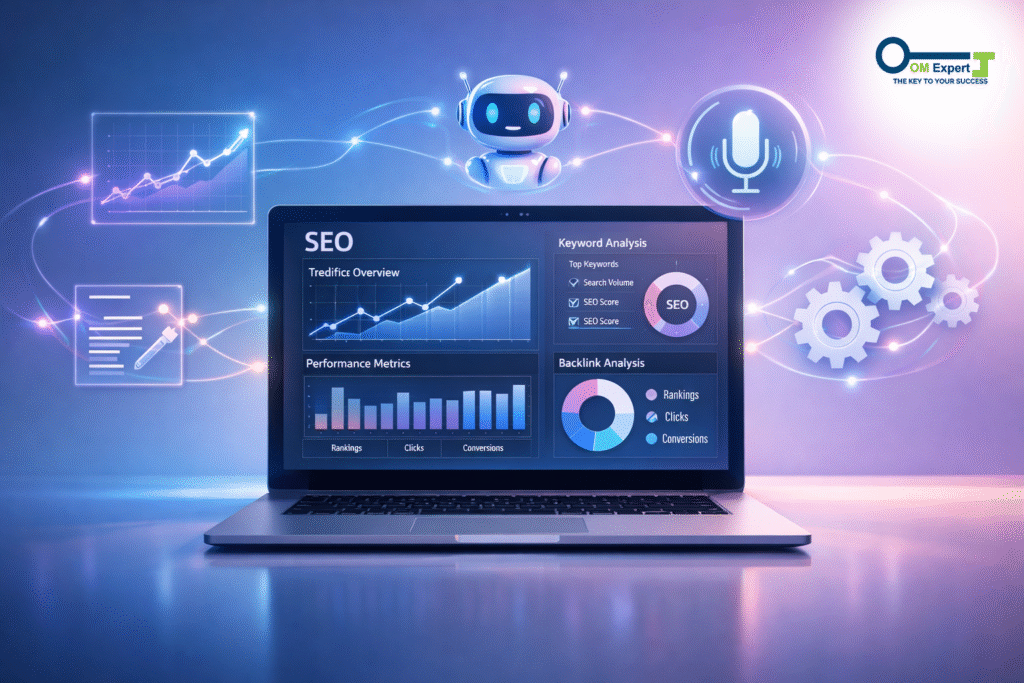
The digital landscape is evolving faster than ever, which requires businesses to establish their online presence. The integration of artificial intelligence into search engine optimization (SEO) has brought about the most significant transformation in recent years. Understanding the future of SEO with artificial intelligence has become essential for businesses that want to improve their online presence and reach their target audience.
AI has developed new tools & technologies that improve search engine optimization through enhanced speed and predictive capabilities. From automated keyword research to content optimization, businesses are leveraging AI-driven strategies to gain a competitive edge. The blog presents current SEO automation trends, essential tools and actionable strategies for future SEO development with artificial intelligence.
What Makes AI a Game-Changer in SEO
The current development of artificial intelligence technology provides multiple methods for transforming search engine optimization practices. SEO work in the past required human operators to complete various tasks, which included keyword research, content development and ranking evaluation. The present time sees AI technology handle these tasks while delivering advanced insights & forecasting capabilities, which help marketers in making better business choices.
- Data Analysis at Scale: AI can process large-scale data processed for search purposes in a few minutes, based on trends that involve patterns in behavior.
- Content Personalization: AI helps personalized content to specific user preferences, enhancing engagement & improving search ranking.
- Automated On-Page SEO: Meta tags, headings, image alt tags and internal links could be automated by AI tools to be made clean to the online standards of SEO on every page.
- Enhanced User Experience Insights: AI checks users interactions, such as clicks, scroll depth & time on page, helping marketers in bettering their site’s structure, navigation and content layout.
- Competitor Analysis at Lightning Speed: This technology monitors competitor websites and their SEO schemes in real time to find out the discrepancies, the emerging trends and the further enhancement in the system.
Businesses today use AI for their search engine optimization activities because new technologies demonstrate their advantages. The future of SEO with artificial intelligence works to empower marketers through enhanced data access, which helps them make better decisions.
Key Trends Shaping the Future of SEO with AI
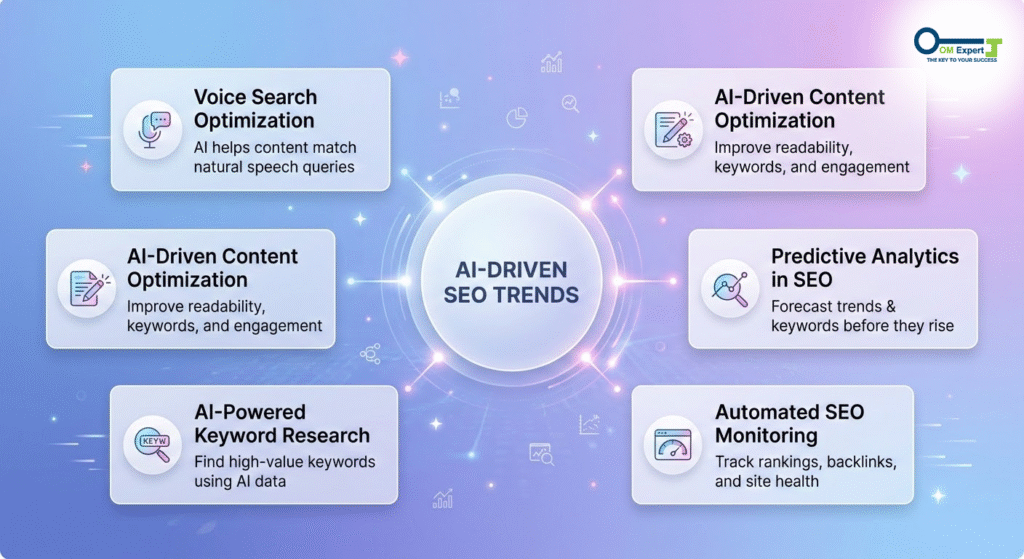
AI tools now enable marketers to work more efficiently while achieving better results through their impact on search engine optimization practices. The main AI-based innovations, which drive search evolution from content enhancement to trend prediction, enable businesses to discover their most effective operational areas for improved performance.
Voice Search Optimization
Voice search has emerged as the primary method through which users conduct online searches. AI-powered natural language processing (NLP) enables search engines to better comprehend spoken language inquiries. Content creators need to develop their work by creating content that matches three specific criteria of long-tail keywords, question-based inquiries and natural sentence structures.
- 2. AI-Driven Content Optimization
AI tools can now check content performance & suggest improvements for better ranking. They evaluate factors such as readability, keyword placement, semantic relevance & user engagement signals.
This allows marketers to refine content quickly & ensure it meets search engine standards while providing real value to readers. The future of SEO with artificial intelligence heavily depends on such AI content optimization techniques.
- 3. Predictive Analytics in SEO
Predictive analytics in SEO enables businesses to forecast Future SEO trends before those trends achieve widespread acceptance. The AI model uses historical search data together with competitor analysis and market trends to predict how keywords will perform.
Businesses can invest in high-potential topics through these insights to maintain their competitive advantage. The future of SEO will rely on predictive analytics, which will be implemented through artificial intelligence.
- 4. AI-Powered Keyword Research
AI platforms find high-value keywords through analysis of search volume, competition and user intent. AI based keyword research tools search through extensive data sets to discover potential opportunities that traditional methods cannot identify.
This makes the keyword selection process more accurate & strategic, which is important for long-term SEO success.
- 5. Automated SEO Monitoring
The manual process of managing SEO performance requires extensive time commitment, which results in a high likelihood of mistakes. The AI-powered Automated SEO tools track website rankings, site health, backlinks and content performance in real time.
The system alerts marketers about potential problems that could affect their search visibility before those problems occur.
Essential AI Tools for SEO Success
The integration of AI tools for SEO optimization is supported by a growing ecosystem of tools made to simplify optimization & enhance results. Here are some popular categories:
- Content Optimization Tools – Platforms that check content structure, suggest keyword placement & improve readability.
- SEO Automation Tools – Tools that manage repeated operations, such as competition analysis, backlink tracking and meta tag production.
- AI SEO Software & Platforms – A full system that includes content performance tracking, predictive analytics & end-to-end SEO suggestions.
- AI SEO Plugins – WordPress & other CMSs have plugins for automating on-page SEO.
These tools not only save time, but they also make SEO efforts better & more accurate, which is exactly what the future of SEO with artificial intelligence will be like.
Strategies for Using AI in SEO
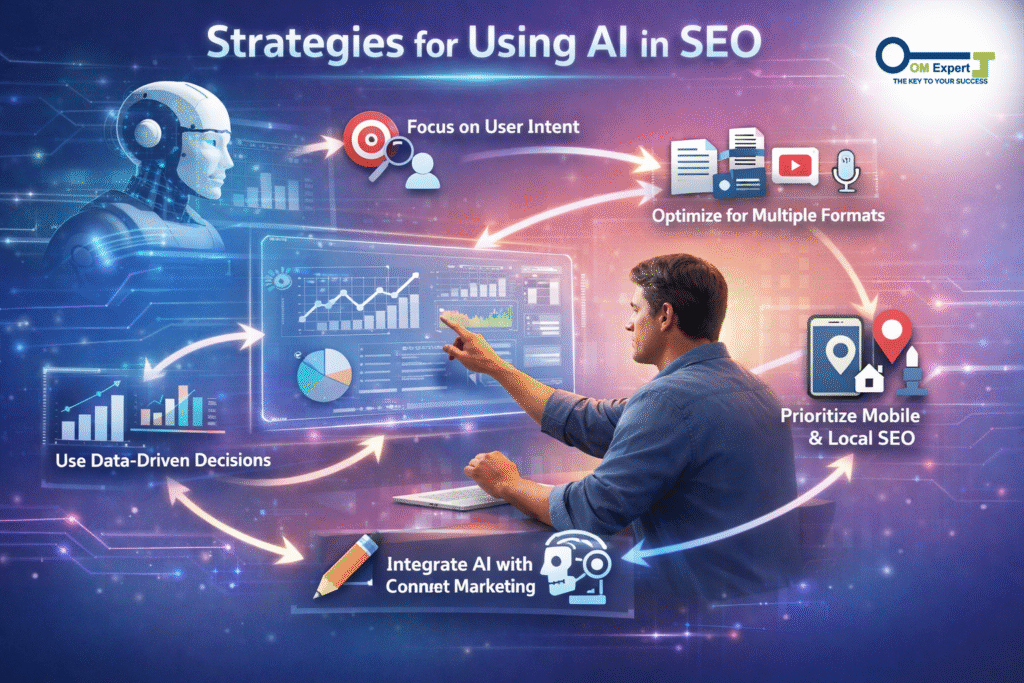
Businesses need to implement strategic practices that integrate human expertise with technological systems because this approach will help them succeed in the AI-driven SEO landscape.
1. Focus on User Intent
AI-based search engines give preference to content that matches the intent of users. The proper creation of relevant content requires you to know what your audience searches for and their reasons for searching.
2. Optimize for Multiple Search Formats
With AI enhancing search engines’ ability to process different types of content, marketers should optimize for text, images, videos, voice search and AI SEO. Rich media content increases engagement and improves search visibility.
3. Use Data-Driven Decisions
AI delivers comprehensive analytical results that show how users interact with the system, track keyword patterns and measure content effectiveness. The use of this Data driven SEO strategies development process will result in improved targeting results, which lead to increased return on investment.
4. Prioritize Mobile and Local SEO
AI helps businesses to identify local customers through analysis of location-based search patterns. Businesses are required to prioritize mobile optimization because their users increasingly search through mobile devices.
5. Integrate AI with Content Marketing
AI identifies current popular subjects and recommends content enhancements while producing initial written material. The combination of AI-generated insights & human creative work results in content that meets high standards of quality & connects with readers.
Challenges and Considerations
AI brings remarkable efficiency & intelligence to SEO, but it also comes with some challenges that businesses need to be aware of. Knowing these limitations ensures AI supports growth instead of causing problems.
- Over-reliance on AI: The AI tools possess great strength. The tools need to assist human decision-making because they should not operate as substitutes for human judgment. Human involvement remains necessary for both creative work and brand comprehension.
- Data Privacy Concerns: The development of artificial intelligence systems requires access to user information. The organization needs to follow GDPR regulations because this compliance protects user trust and prevents legal complications.
- Keeping Up with AI Updates: Search engines update their AI algorithms on a continuous basis & marketers should adapt accordingly to keep their brands effective.
- High Initial Investment: Businesses must evaluate ROI & plan for long-term benefits because advanced AI solutions may be costly.
- Quality Control of AI Generated Content: Though AI can produce content rapidly, careful editing is required to ensure the content is accurate.
- Integration Challenges: It can be challenging to integrate AI with current SEO tools & operations and it can require guidance & training.
The future of SEO through artificial intelligence shows positive prospects despite these existing difficulties. AI improves efficiency and content quality when used in intelligent ways, which helps businesses respond better to market changes. The key to success in the digital world requires businesses to use artificial intelligence as a tool that works together with human experts, who apply their expertise to make innovative and strategic business decisions.
Future Outlook
In the future, AI will keep improving search engine ranking, experience personalization and trend prediction. Some emerging developments have:
- Growing use of generative AI algorithms to make web-based content that possesses a high SEO rating.
- Advanced parsing to predict variations in human search behavior.
- Competitor check based on AI to offer strategic insights
- Most digital marketing involves AI from keyword research to content promotions.
Businesses that embrace these changes early will be positioned as early leaders in the digital space.
Conclusion
The future of SEO with artificial intelligence is already unfolding. The artificial intelligence system, which marketers use to conduct their keyword research, content optimization and performance tracking activities of their marketing campaigns, has created a new method for carrying out these tasks. The AI system delivers advanced SEO tools that enable website owners to improve their search engine optimization through its predictive analytics system, its automated monitoring capabilities and its voice search optimization feature.
Businesses seeking to benefit from current technological advancements should investigate all existing artificial intelligence search engine optimization solutions, which include both automated tools and content optimization software. OmExpert provides businesses with expert AI-driven SEO guidance through its detailed resources and effective solutions, which help organizations maintain their competitive edge in this fast-changing industry.
FAQs
1. What is AI SEO and how is it different from traditional SEO?
AI SEO uses artificial intelligence to automate SEO tasks like keyword research, content analysis, and ranking tracking. Unlike traditional SEO, it delivers faster insights and personalized strategies.
2. How does AI improve keyword research?
AI analyzes search volume, competition, and user intent to identify high-value keywords that traditional methods may miss. This helps businesses target the most effective terms for long-term SEO success.
3. Can AI help optimize content for better rankings?
Yes. AI tools evaluate readability, keyword usage, semantic relevance, and user engagement, offering actionable suggestions to improve content quality and boost search rankings.
4. Can AI monitor SEO performance automatically?
Yes. AI tools track rankings, site health, backlinks, and content performance in real time, alerting marketers to potential issues before they impact search visibility.
5. Are AI SEO tools useful for small businesses?
Absolutely. AI SEO tools help small businesses automate repetitive tasks, track performance, and gain insights quickly, allowing them to compete effectively with larger brands without extensive resources.
Digital PR is no longer just about backlinks or media coverage; it’s a strategic tool for improving Digital PR for AI visibility. By connecting authoritative mentions, structured content, and expert insights, brands can signal credibility and relevance to AI systems.