
Everything you need to know about Google's stance on AI content
Artificial Intelligence is transforming the nature of content on the web. Companies, bloggers, and digital marketers use artificial intelligence software to produce articles, suggest ideas, and accelerate their publishing cycle. But one important question keeps coming up: What exactly is Google’s stance on AI content? It is also the responsibility of search engines to return valuable, reliable information to users.
With the rise of Artificial Intelligence and other such technologies, Google has issued guidelines to ensure that its quality content remains high on the search ranking. This guide will teach you: how Google identifies AI content, what requirements Google has, and how to utilize AI ethically without underperforming your SEO. The objective is to understand how AI can be used to support content creation while still meeting Google’s quality guidelines.
Understanding Google‘s Stance on AI Content
Google has made it clear that it does not penalize an entity by default just because the content was created by AI. The content can be deemed good only if it has been helpful, informative, and relevant to the audience. This approach underscores that Google’s stance on AI content prioritizes helpfulness rather than the process used to produce content. Like any other tool, AI is available to writers. For example, writers can use grammar checkers and editing software alongside AI writing tools to search, outline, or write content.
Google AI Content Policy
The Google AI content policy states that content should be useful to users. If AI is used to generate large volumes of poor-quality or spammy text just to game the rankings, then it breaches Google‘s policies.
Google looks at content for usefulness, quality, and originality. Recognizing Google’s stance on AI content ensures your strategy aligns with search engine requirements.
AI-Generated Content Guidelines
To protect the integrity of the web, Google has implemented straightforward rules for content written by AI. The rules state that this is to be evaluated based on the content‘s impact on the user experience, holding that:
Content must effectively deliver information to the reader.
- Information needs to be reliable and trustworthy.
- The tools are not developed to create spam.
- Human review is highly advised.
Google’s stance on AI content states that AI can be used ethically and appropriately.
How AI Content Affects SEO and Search Rankings
The top concern among marketers is the search performance of AI-created articles. Understanding how Google’s stance on AI content helps companies create SEO-friendly content.
Google Search Policy on AI Content
The Google search policy on AI content emphasizes spam prevention and user experience. “If you create pages with main content that’s only there to manipulate rankings, without helping users, those pages may be considered spam.”
Google‘s algorithms are built to identify signals of poor-quality automation. Understanding Google’s stance on AI content ensures that your AI-assisted pages provide real value to users.
AI-Written Content and Search Rankings
Whether the site ranks highly or not will ultimately depend on quality. If the site contains well-researched and informative articles, then it may well rank just as well because of the use of AI. However, websites that rely heavily on unedited AI content often face issues such as:
- Low engagement from readers
- Poor credibility
- Declining rankings over time
Familiarity with these Google standards for AI content can prevent such issues and help preserve high search rankings.
AI Content SEO Best Practices
Adhering to AI content SEO best practices is a way for businesses to use the speed of AI and the expertise of human writers to their best advantage. These practices – which keep the focus on quality, readability, and trust include:
Key strategies include:
- Editing AI drafts carefully
- Including expert advice and examples
- Ensuring factual accuracy
- Improving readability for users
Following these steps aligns your content with Google’s helpful content update for AI and reflects Google’s stance on AI content in practice.
Google‘s Quality Standards for AI Content
Google qualifies content using comprehensive quality systems. These systems ensure the reliability of the information selected for the user, no matter how it was created.
AI Content Quality Guidelines
AI guidelines for content quality stress information rather than text quantity. A website publishing fewer high-quality articles ranks higher than a website generating a huge amount of low-value content. Google recommends that publishers concentrate on depth, originality and dependability.
Google Search Quality Guidelines AI
The Google search quality guidelines AI highlight the importance of helpful content, expertise, and transparency. These guidelines are used by search quality evaluators to assess whether a webpage provides real value. Content that demonstrates expertise and authority tends to rank higher in search results.
Automated Content Google Policy
The automated content Google policy addresses content created entirely by automated systems without human review. Google considers this type of content risky when it is produced mainly to manipulate search rankings. Using automation responsibly is important for maintaining credibility and search visibility.
AI Tools for Content Creation SEO
Many marketers use AI tools for content creation and SEO to speed up research, generate outlines, or produce drafts. When used correctly, these tools can improve productivity while maintaining high content standards. However, AI should always support human creativity rather than replace it entirely.
Ranking Factors and Trust Signals for AI Content
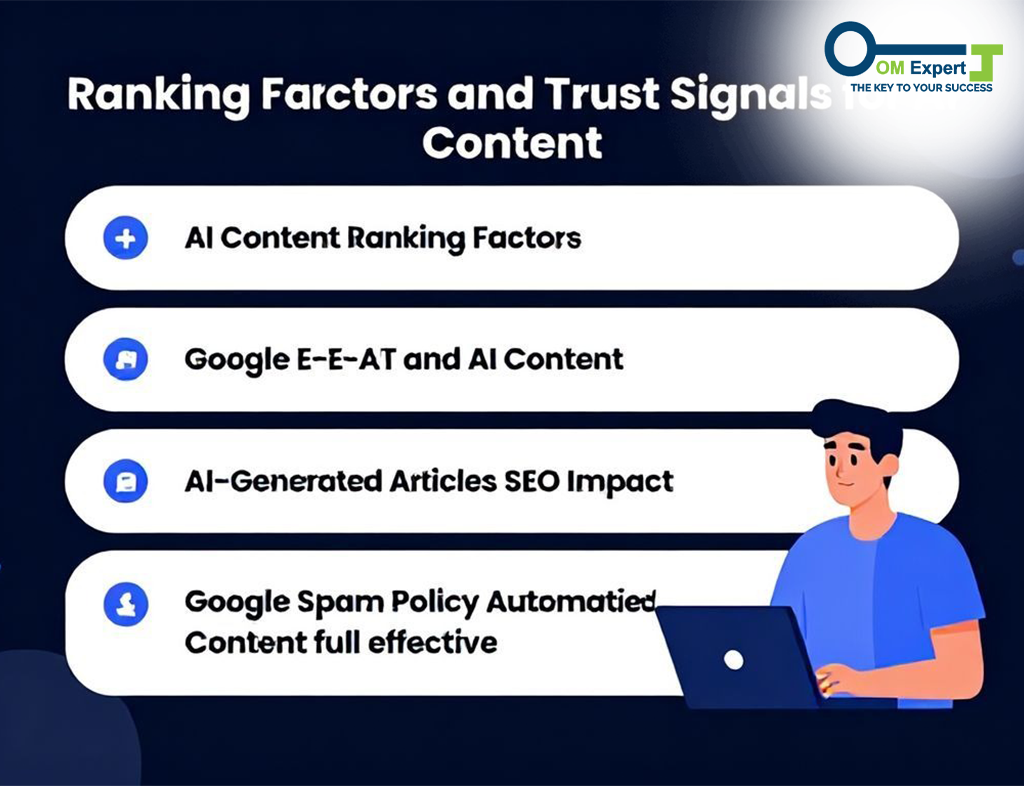
Search engines evaluate many signals when ranking content. Understanding these signals helps ensure AI-assisted articles meet Google’s expectations.
AI Content Ranking Factors
The main AI content ranking factors are similar to those used for traditional content. Google evaluates:
- Relevance to the search query
- Content depth and usefulness
- User engagement
- Authority of the website
Well-optimized AI content that addresses these factors follows Google’s stance on AI content principles.
Google E-E-A-T and AI Content
Google uses the Google E-E-A-T and AI content framework to evaluate expertise, experience, authority, and trustworthiness. Even if AI helps generate text, content should reflect real knowledge and reliable sources. Websites that demonstrate expertise tend to gain stronger rankings and credibility. Properly reviewed AI content meets Google’s stance on AI content standards and can rank well.
AI-Generated Articles SEO Impact
The AI-generated articles’ SEO impact depends on how the content is created and managed. When AI content is edited, fact-checked, and improved by humans, it can perform well in search engines. But mass-produced automated articles often lead to lower rankings and reduced trust.
Google Spam Policy Automated Content
The Google spam policy automatically targets websites that generate large volumes of low-quality text designed solely to manipulate search results. These sites may face ranking penalties or removal from search results. Maintaining quality standards helps avoid such issues.
Responsible and Ethical Use of AI in Content Creation
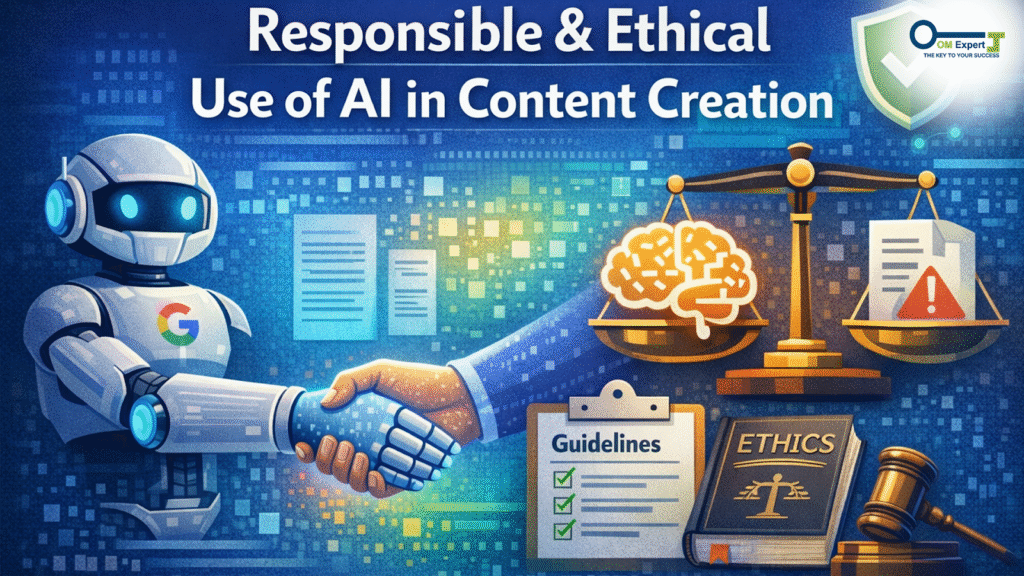
AI technology is powerful, but it must be used responsibly. Content creators should focus on building trust with readers and search engines.
Ethical Use of AI in Content
The ethical use of AI in content involves transparency, accuracy, and respect for readers. Content creators should avoid misleading information or publishing AI-generated text without verification. Ethical practices strengthen audience trust and brand reputation.
AI-Assisted Writing & SEO
Many professionals now use AI-assisted writing and SEO workflows to improve efficiency. AI can help generate ideas, draft outlines, and assist with keyword research. Human writers then refine the content, add insights, and ensure the article meets quality standards.
Search Engine Tips for AI Content
The search engine guidelines for AI content emphasize creating information that genuinely helps users. Following these guidelines ensures long-term SEO success. Content should answer real questions and provide meaningful value to readers.
Google Algorithm & AI-Generated Text
The Google algorithm and AI-generated text systems analyze multiple signals to determine content quality. Google’s algorithms are constantly evolving to detect spam while rewarding helpful information. This means that responsible AI use can still lead to strong search performance.
Best Practices for Publishing AI Content
Content creators should follow structured processes when publishing AI-assisted articles. These practices help maintain credibility and search performance.
AI-Content Publishing Best Practices
Effective AI content publishing best practices include reviewing and improving AI drafts before publishing. Human editing ensures that the final article meets professional standards.
AI-Content Quality vs Quantity SEO
A common mistake in SEO is focusing on volume instead of quality. The concept of AI content quality vs quantity SEO highlights that fewer high-quality articles perform better than hundreds of weak ones. Quality content builds authority and long-term rankings.
Responsible AI-Content Creation
Responsible AI content creation means combining automation with human expertise. Writers should verify facts, improve readability, and ensure the content reflects real knowledge.
AI Content Detection & Google
Many people worry about AI content detection and Google. While Google has systems that identify spam automation, it does not penalize content simply because AI helped create it. Quality and usefulness remain the most important ranking factors.
AI-Content Optimization Strategies
Effective AI content optimization strategies include improving structure, adding examples, and ensuring clear explanations. Optimized articles provide a better experience for readers.
Risks and Compliance When Using AI Content

While AI offers many benefits, it also comes with risks that content creators should understand.
Human-Edited AI Content SEO
The concept of human-edited AI content SEO emphasizes that AI-generated drafts should always be reviewed by real writers. Human editing improves accuracy, tone, and readability.
AI-Content Risks in SEO
Some common AI content risks in SEO include publishing inaccurate information, producing repetitive articles, and creating thin content with little value. Avoiding these risks requires careful editing and research.
AI-Content Compliance with Google Guidelines
Ensuring AI content compliance with Google guidelines is essential for maintaining search visibility. Websites that follow Google’s quality standards are more likely to succeed in the long term.
Future of AI Content:
The future of AI content in search will likely involve greater collaboration between humans and machines. AI will continue to improve, but human expertise will remain important for trust and credibility.
AI-Content & Website Credibility
High-quality AI-assisted articles can strengthen AI content and website credibility when they are accurate, informative, and well-edited.
AI-Content Transparency Guidelines
The AI content transparency guidelines suggest that publishers should be open about how content is created when appropriate. Transparency helps build trust with readers.
SEO Strategies for AI-Generated Content
Successful SEO strategies for AI-generated content focus on improving user experience, adding unique insights, and maintaining high editorial standards.
Google Search Updates & AI-Content
Recent Google search updates and AI content developments show that Google is continuously improving its systems to detect low-quality automation while rewarding helpful content.
AI-Content Trust & Authority
Ultimately, the success of AI-generated articles depends on AI content trust and authority. When readers trust the information on a website, search engines are more likely to rank that content higher.
Conclusion
Artificial intelligence is transforming the way content is created, but quality and usefulness remain the foundation of successful SEO. Understanding Google’s stance on AI content helps content creators use AI responsibly while maintaining strong search performance. Google does not reject AI-generated text. Instead, it evaluates whether the content is helpful, accurate, and trustworthy for users.
When AI tools are combined with human expertise, businesses can produce informative content that meets both reader expectations and search engine standards. Organizations that focus on ethical AI use, careful editing, and valuable insights will continue to succeed in the evolving digital landscape. For businesses looking to strengthen their digital presence and implement effective SEO strategies, OM Expert provides professional digital marketing solutions that support sustainable online growth.